

 Ulkar Ismayilova1 , Rashad Ismayilov2 , Ulaş Kumbasar3 , Olcay Kurtulan4 , Gamze Durhan5 , Emre Ünal5 , Türkmen Turan Çiftçi5 , Deniz Köksal6
 2Department of Medical Oncology, Baskent University Faculty of Medicine, Ankara, Türkiye
3Department of Thoracic Surgery, Hacettepe University Faculty of Medicine, Ankara, Türkiye
4Department of Pathology, Hacettepe University Faculty of Medicine, Ankara, Türkiye
5Department of Radiology, Hacettepe University Faculty of Medicine, Ankara, Türkiye
6Department of Chest Diseases, Hacettepe University Faculty of Medicine, Ankara, Türkiye

Abstract
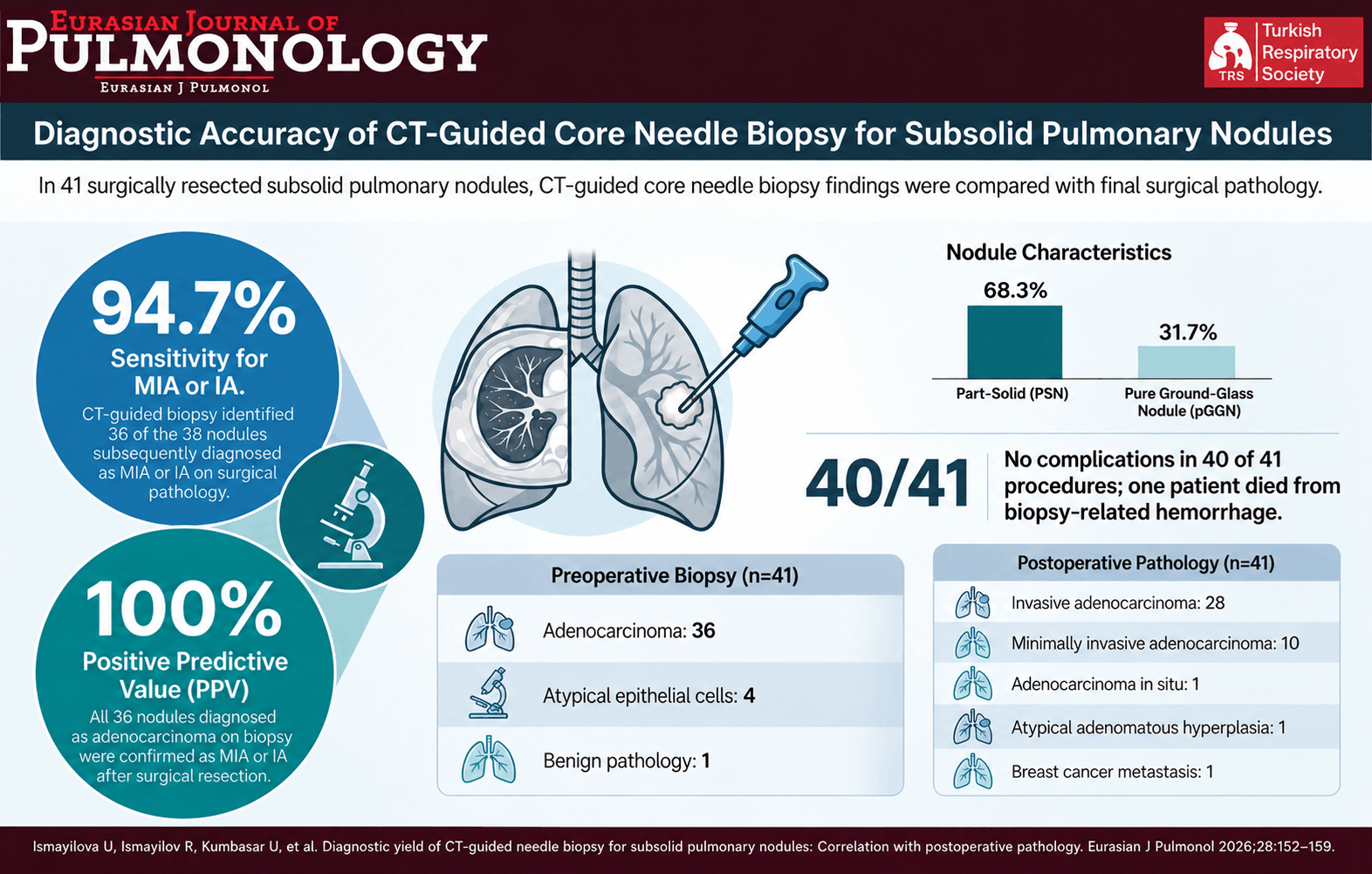
BACKGROUND AND AIM: Subsolid pulmonary nodules (SSNs), encompassing pure ground-glass nodules (pGGNs) and part-solid nodules (PSNs), may represent a spectrum of pulmonary adenocarcinoma. Accurate preoperative diagnosis is essential to guide treatment decisions and avoid unnecessary surgeries. This study aimed to evaluate the diagnostic performance of computed tomography-guided transthoracic core needle biopsy (CT-TNB) in SSNs, with correlation to final surgical pathology.
METHODS: This retrospective cohort study included 41 SSNs from 40 patients who underwent CT-TNB followed by surgical resection between 2012 and 2022. Radiological and histopathological characteristics were evaluated. Descriptive statistics and diagnostic performance metrics were calculated using Python.
RESULTS: Of the 41 SSNs, 13 (31.7%) were pGGNs and 28 (68.3%) were PSNs. CT-TNB diagnosed 36 nodules (87.8%) as adenocarcinoma, four (9.8%) as atypical epithelial cells, and one (2.4%) as benign pathology. Final pathology revealed 28 (68.3%) invasive adenocarcinomas (IA), 10 (24.4%) minimally invasive adenocarcinomas (MIA), one adenocarcinoma in situ, one atypical adenomatous hyperplasia, and one breast cancer metastasis. CT-TNB demonstrated 97.6% sensitivity and 100% positive predictive value (PPV) for malignancy. For invasive carcinoma (MIA or IA), sensitivity was 94.7%, with 100% specificity and PPV.
CONCLUSIONS: CT-TNB demonstrates high diagnostic accuracy for SSNs and correlates reliably with postoperative pathology. It remains a valuable tool for preoperative assessment when performed by experienced teams using core needle techniques.
Graphical Abstract